
If you’re looking for a rugged off-road SUV in India, Mahindra Thar vs Maruti Jimny is one of the hottest debates. In this review I’ll compare them deeply — from engine, capability, comfort, features, pros & cons — so you can decide which one suits you best. (Yes, I’ll speak from my experience, but also bring in real specs and data so it’s grounded.)
Table of Contents
Introduction
Mahindra Thar vs Maruti Jimny — which one truly deserves the title “Best Off-Road SUV in India”? Right from the start, we’ll compare them on performance, capability, comfort, features, and real-world usability. Throughout this review, I will use that focus keyword — Mahindra Thar vs Maruti Jimny — in natural places, without overstuffing. By the end, you’ll know which one makes more sense for your needs.
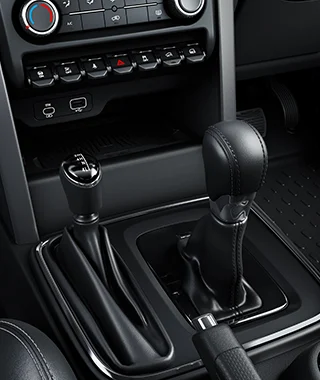
Background & Positioning
Mahindra’s Thar has long been a favorite among off-road enthusiasts in India. It combines retro styling, rugged build, and a strong aftermarket support. The newer versions (and the 5-door version called Thar ROXX) push it even more into the lifestyle SUV territory.
Maruti Suzuki revived the Jimny nameplate in India with the 3-door, then introduced the 5-door version too. It’s built on a ladder frame, with serious off-road hardware to appeal to buyers who want compact but capable SUVs.
So on paper, both are “off-road SUVs,” but they try to balance road usability, comfort and features differently.
Technical Specifications & Powertrain
Here’s a side-by-side look:
| Parameter | Mahindra Thar | Maruti Jimny |
|---|---|---|
| Engine options | Petrol: 2.0L mStallion turbo (≈ 150 bhp) Diesel: 2.2L mHawk (≈ 130–150 bhp, ~300 Nm) | 1.5L petrol (K15B) ~103 bhp, ~130 Nm torque |
| Transmission | 6-speed manual, 6-speed automatic (torque converter) | 5-speed manual, 5-speed automatic (in some markets) |
| Drivetrain / 4WD system | Available with 4×4 low-range, part-time 4WD system, ladder frame, all-terrain suspension | Dedicated 4WD system (ALLGRIP PRO) with low-range transfer case; ladder frame; rigid axles front & rear |
| Dimensions & weight | Length ~ 3985 mm (for 3-door) | Length ~ 3985 mm (similar footprint), wheelbase ~ 2590 mm |
| Mileage / Fuel efficiency | Reported ~14.5 to 15 kmpl (diesel) in real usage; petrol ~12-13 kmpl (user claims) | ARAI claimed ~16.39 to 16.94 kmpl |
From this table, you see the Thar offers more displacement variety and higher torque (especially in diesel), while Jimny is more modest in power but lighter and efficient.
Off-Road Capability
This is where things matter most for an off-road SUV.
Chassis & Suspension
- Thar uses a body-on-frame ladder chassis, rugged suspension tuned for off-road conditions. It offers strong underbody protection and load-bearing capacity.
- Jimny’s ladder frame with rigid axles front and rear, and the ALLGRIP PRO system gives it serious off-road chops, especially in compact terrain where dimensions matter.
4WD & Low-Range
- Thar’s 4×4 system allows you to switch modes, with a low-range transfer case for steep climbs, rock crawling, etc.
- Jimny’s 4WD with low-range gear gives it excellent torque multiplication in tough terrain.
Angles & Ground Clearance
- Jimny is known for generous approach, departure, breakover angles, allowing it to handle steep slopes without scraping bumpers.
- Thar also offers good clearance and rugged bumpers, though in extreme trails the longer overhangs might bite you.
Traction Control, Differentials & Electronics
- Jimny has features like LSD (Limited Slip Differential) traction control, hill hold and descent controls, etc.
- Thar’s electronic aids, stability control, etc., are competitive though it leans a bit more mechanically rugged (less electronic intervention).
In many tough trails, the lighter Jimny may have an edge in narrow paths, but in deep sand, rock, and rugged terrain, Thar’s bigger torque and heavier weight help it push through.
Interior & Comfort
You don’t just drive off-road; daily usability matters too.
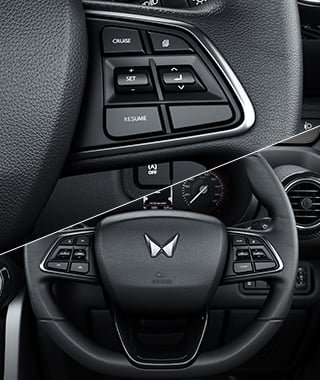
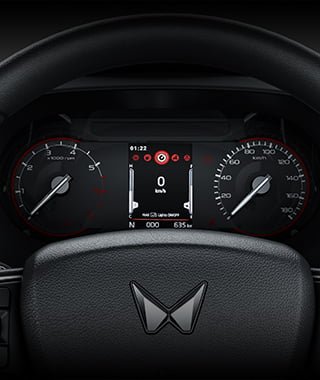
- Thar offers a more spacious cabin (depending on variant), with modern infotainment, digital cluster, connectivity, comfort features.
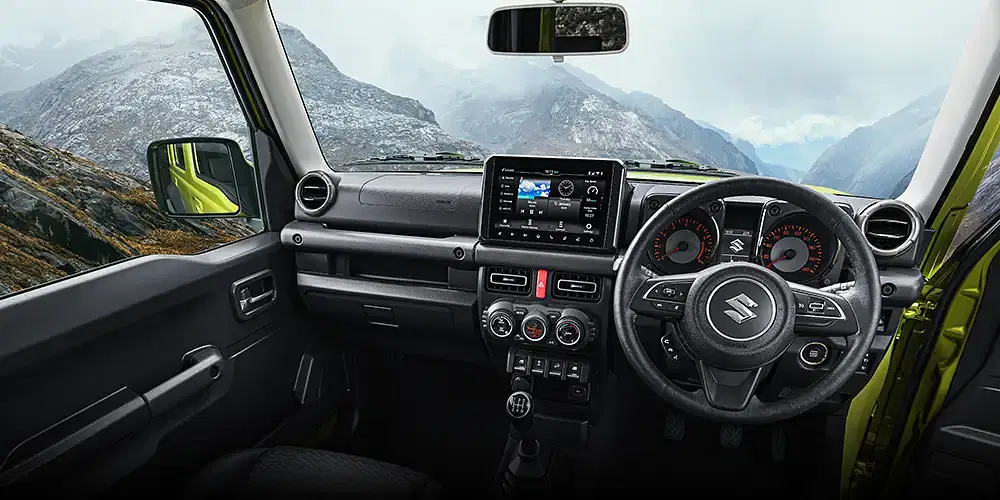
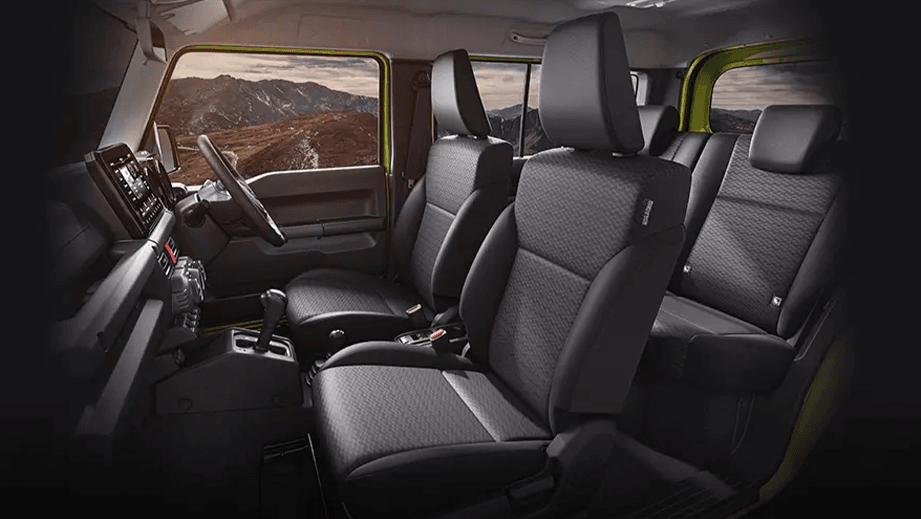
- Jimny’s interior is more utilitarian. It is functional, durable, with basics in place. For off-road users, this works well. But on long highway drives, you may feel more fatigue.
- Noise, vibration and harshness (NVH) is better in Thar because of more engineering investment.
- Rear seating and luggage space will favor Thar (especially 5-door Thar ROXX) over Jimny in daily use.
So for daily usability and comfort, Thar takes an edge.
Features, Safety & Tech
You want modern features and safety too.
- Thar comes with LED lighting, touchscreen infotainment with Android Auto / Apple CarPlay, connected car features, rear-view camera, etc.
- Jimny offers basic but relevant features: hill hold, descent control, traction aids, etc. More premium features depend on market and trim.
- In safety, both offer stability control, airbags, but Thar has the advantage of size and structure in crashes.
- For further reading on SUVs, check this internal link: [Kawasaki Ninja H2R vs H2 comparison]
You may also want to glance at the official Maruti / Suzuki site for Jimny details and updates.
Pros & Cons Based on My Experience & Reported User Feedback
Thar – Pros
- Strong off-road muscle in rugged terrain
- Spacious cabin & better for daily use
- More torque options, engine variety
- Better road manners, better NVH
- Strong service and aftermarket support across India
Thar – Cons
- Heavier, so in tight trails may struggle vs lighter SUV
- Fuel efficiency suffers in city
- More expensive to maintain (tires, parts)
Mahindra Thar Official Website
Jimny – Pros
- Compact, agile, perfect for narrow trails
- Simpler mechanics (less to break)
- Good fuel efficiency in day use
- Light weight helps in tricky obstacles
Jimny – Cons
- Less power and torque in extreme conditions
- Cabin feels basic, long drives less comfortable
- Less space for passengers/luggage
- Fewer features compared to rivals
Maruti Suzuki Jimny Official Page

Which One Should You Choose?
It depends on what you prioritize.
- If extreme off-roading, power, daily usability, comfort — go for Thar.
- If compact trails, lighter terrain, simplicity, cost-effectiveness — Jimny makes sense.
If I were to pick for myself (someone who uses it both for weekend trails and daily drives), Thar gives a more balanced package. But for a hardcore trail junkie who needs nimbleness, Jimny is attractive.
Final Verdict
In the battle Mahindra Thar vs Maruti Jimny, there is no one-size-fits-all winner. Thar is stronger overall if you want that rugged, feature-rich off-road SUV that also handles city and highway well. Jimny is leaner, tougher in tight trails, and more economical in simple use.
If you want a recommendation: pick Thar unless your adventures are limited to very narrow offbeat routes where size becomes a liability.