
Introduction
If you’re a fan of superbikes, then you’ve definitely heard of the Kawasaki Ninja H2R and Kawasaki Ninja H2. These two machines are not just motorcycles — they’re engineering marvels that push the limits of what’s possible on two wheels. In this complete review, I’ll share everything I’ve learned about both bikes — from performance and design to features and real-world riding impressions. I’ll also compare them side by side so you can decide which one truly deserves your attention.
Before we dive in, if you love high-performance motorcycles, check out our detailed KTM Duke 990 Review on UpdateSnap. It’s another beast worth reading about.
Table of Contents
What Makes the Kawasaki Ninja H2 and H2R So Special?
When it comes to supercharged power, no bike stands taller than the Ninja H2 series. The Kawasaki Ninja H2R and Kawasaki Ninja H2 share the same DNA — both powered by a 998cc inline-four engine with a supercharger. But their personalities are completely different.
The Ninja H2R is a track-only hyperbike, while the Ninja H2 is the street-legal version designed for road use. Both bikes deliver heart-racing acceleration, mind-blowing top speeds, and cutting-edge technology that feels ahead of its time.
I still remember the first time I saw an H2R in person — it didn’t even look real. The carbon fiber wings, the polished mirror-finish bodywork, and the sound of the supercharger made it feel more like a jet than a motorcycle.
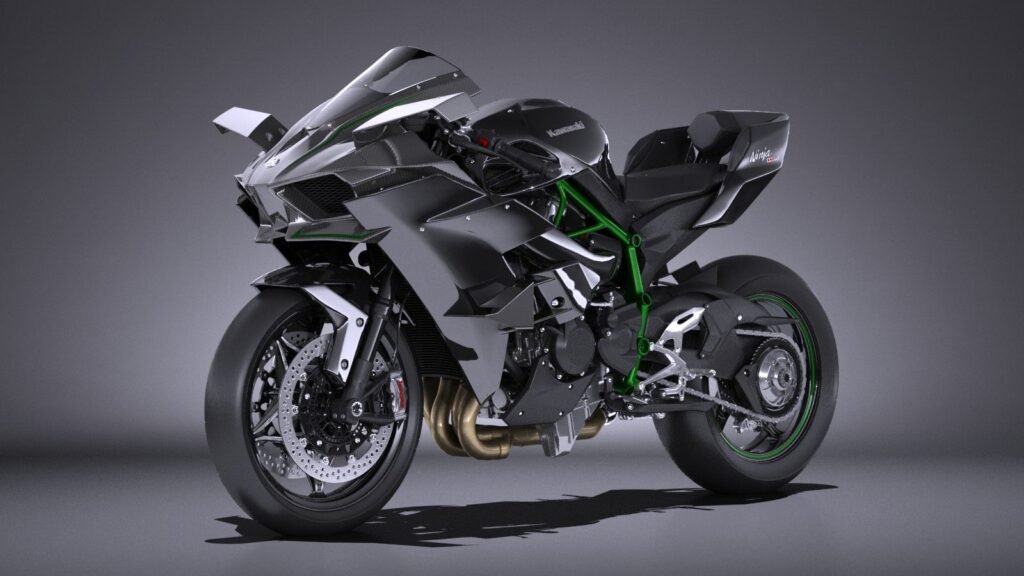
Kawasaki Ninja H2R – The Track Monster
The Kawasaki Ninja H2R is the fastest and most powerful production motorcycle ever built by Kawasaki. It’s designed purely for track use and not legal for public roads.
Here’s what makes it so incredible:
- Engine: 998cc supercharged inline-four
- Power Output: 310 PS (326 PS with Ram Air)
- Torque: 165 Nm
- Weight: 216 kg
- Top Speed: Over 400 km/h (claimed)
- Frame: Trellis frame with single-sided swingarm
- Bodywork: Full carbon fiber with aerodynamic wings
The Ninja H2R uses a centrifugal supercharger developed in-house by Kawasaki. It’s not just a turbo boost — it’s a piece of advanced engineering that delivers instant power without lag. The way it pulls from 10,000 rpm feels unreal.
Even though it’s not road legal, the H2R gives you an idea of Kawasaki’s ambition — to build the ultimate superbike with no limits.
You can learn more about this machine directly from its official Kawasaki website.
Kawasaki Ninja H2 – The Road-Legal Powerhouse
The Kawasaki Ninja H2 is the street version of the H2R, which means you can actually ride it on public roads. But don’t let that make you think it’s any less thrilling.
It comes with the same 998cc supercharged engine but tuned for practical riding. Here’s what you get:
- Power Output: 231 PS (with Ram Air)
- Torque: 141 Nm
- Weight: 238 kg
- Top Speed: Around 330 km/h
- Brakes: Brembo Stylema calipers
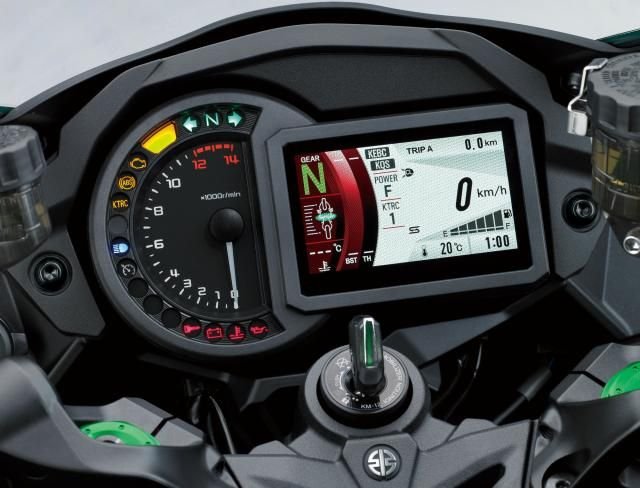
- Electronics: Kawasaki Cornering Management, Launch Control, ABS, and Quick Shifter
When I rode the H2 for the first time, it honestly scared me. The throttle response is instant, and the power delivery feels endless. Yet, it’s surprisingly comfortable for a superbike. The seat is well-padded, and the riding position isn’t as aggressive as you might expect.
The H2 also gets a full-color TFT display, smartphone connectivity, and premium fit and finish all around. Every bolt and curve on this bike screams quality.
Design and Aerodynamics
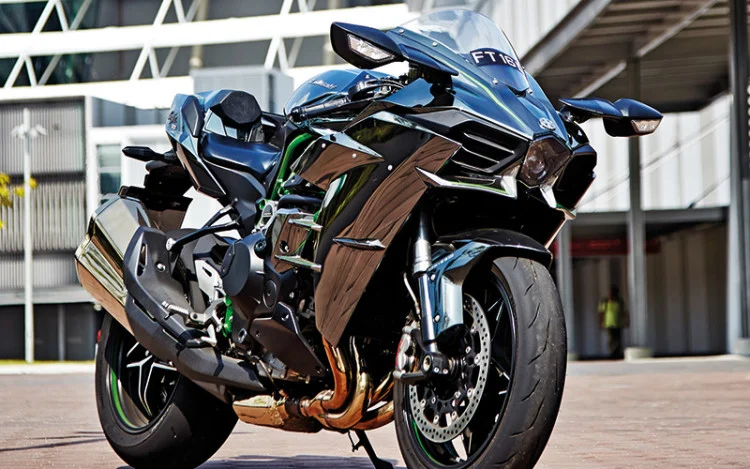
Both bikes share a futuristic design that looks like it belongs in a sci-fi movie. The mirror-coated matte black finish on the H2 and the carbon fiber fairing on the H2R are breathtaking.
The aerodynamics are carefully crafted — the front wings help keep the bike stable at extreme speeds. The winglets on the H2R aren’t just for looks; they actually produce downforce, just like in Formula 1 cars.
Even standing still, the bike looks fast. When you see one in person, it’s hard not to stare.
Riding Experience – Real Impressions
I’ve had the chance to ride the Kawasaki Ninja H2 on open highways, and it’s a machine that demands respect. You can feel the supercharger whine as it spools up — that sound is addictive.
The acceleration is brutal but smooth. The H2 can go from 0 to 100 km/h in just about 2.5 seconds. At high speeds, the stability is outstanding, and the brakes inspire total confidence.
The Ninja H2R, on the other hand, is a different animal. I’ve only seen it on track days, but every rider I’ve talked to says the same thing — it’s unbelievably powerful. Most people never even push it to full throttle because it’s just that wild.
If you want something you can actually use on public roads, go for the H2. But if you want to own the most powerful bike in the world, the H2R is unmatched.
Key Differences: H2R vs H2
Here’s a quick comparison to make things clearer:
| Feature | Kawasaki Ninja H2R | Kawasaki Ninja H2 |
|---|---|---|
| Engine | 998cc supercharged inline-4 | 998cc supercharged inline-4 |
| Power | 310 PS (326 PS with Ram Air) | 231 PS (with Ram Air) |
| Torque | 165 Nm | 141 Nm |
| Weight | 216 kg | 238 kg |
| Top Speed | 400+ km/h | 330 km/h |
| Road Legal | No | Yes |
| Body | Carbon fiber | Steel trellis frame |
| Use | Track only | Street and highway |
Technology and Features
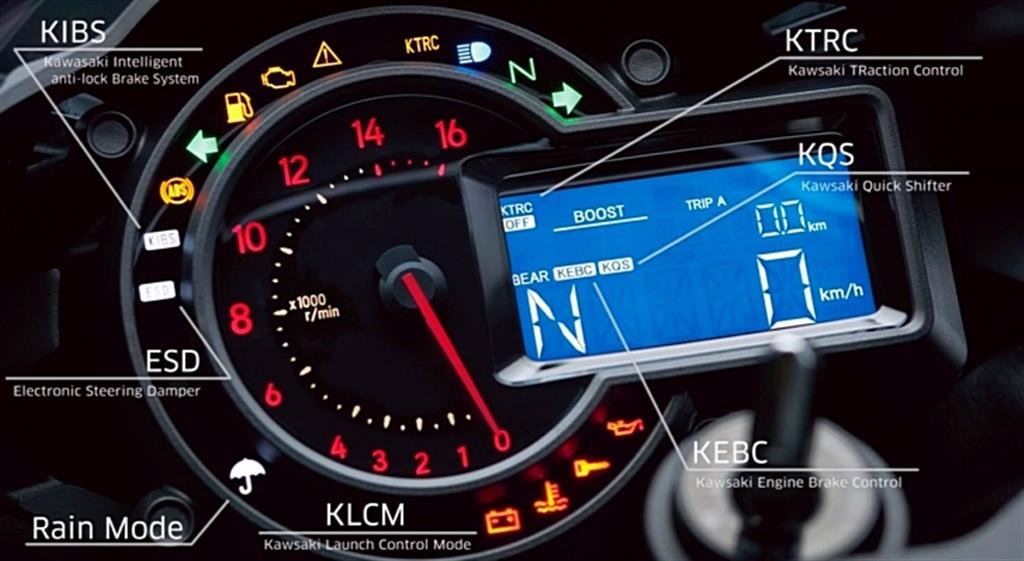
Both bikes are packed with cutting-edge features. Some of the main highlights include:
- Kawasaki Traction Control (KTRC)
- Kawasaki Launch Control (KLCM)
- Kawasaki Cornering Management Function (KCMF)
- Kawasaki Intelligent ABS (KIBS)
- Quick Shifter
- TFT Display with Bluetooth
One thing I really like about Kawasaki is that they’ve not just focused on power but also on rider safety and control. Even at high speeds, the electronic aids work flawlessly to keep the ride predictable.
Price and Availability
Both the Kawasaki Ninja H2R and H2 are premium machines, and their prices reflect that.
In India, the Kawasaki Ninja H2 is priced around ₹79.9 lakh (ex-showroom), while the H2R is available for a staggering ₹79.9 lakh to ₹90 lakh, depending on the year and model.
These bikes are imported in limited numbers, and only a few units are sold each year. Owning one is not just about performance — it’s about exclusivity.
Maintenance and Ownership Experience
Owning an H2 or H2R is not for everyone. The maintenance cost is high, and the supercharged engine requires careful tuning. But if you’re passionate about motorcycles and love engineering excellence, you’ll find it worth every rupee.
Servicing should always be done at an authorized Kawasaki service center, and it’s important to use high-quality fuel and oil.
I’ve met a few owners who say the attention these bikes get on the road is unmatched. You can’t stop anywhere without someone asking for photos or videos.
Final Verdict – Which One Should You Buy?
If you want a legal superbike that can dominate highways, go for the Kawasaki Ninja H2. It’s still insanely powerful but can be registered and used daily if you can handle the fuel bills.
If you’re a collector or track racer and want the fastest production motorcycle ever made, the Kawasaki Ninja H2R is your dream machine. It’s raw, rare, and ridiculously fast — a true statement of Kawasaki’s engineering power.
In my experience, both bikes are masterpieces. The H2 feels more usable, while the H2R feels like something from another planet.
Conclusion
The Kawasaki Ninja H2R vs H2 debate isn’t about which one is better — it’s about what kind of rider you are. Both are engineering icons, built with passion and precision. Whether you crave street-legal speed or track-only madness, Kawasaki has given us two motorcycles that redefine performance.
If you want to explore more superbike reviews and latest launches, visit UpdateSnap.com.